
Feria del Carmen & Feria de Málaga: The Complete Guide for Visitors Staying in Torremolinos
If you’re staying in Torremolinos this summer, you’re actually sitting right in the middle of two of the Costa del Sol’s biggest celebrations — and they’re not the same festival, even though the names get mixed up online all the time. First, there’s the Feria Virgen del Carmen, a maritime festival honouring the patron saint of fishermen, which takes over Torremolinos’s own seafront neighbourhood of La Carihuela every July. Then, a month later, there’s the Feria de Málaga, the city’s enormous week-long summer fair, held in the historic centre and at a dedicated fairground on the edge of town. This guide covers both, so you know exactly what’s happening, when, and whether it’s worth stepping outside your hotel or hopping on a train. Spoiler: for one of these festivals, you won’t need to go anywhere at all.Feria Virgen del Carmen in La Carihuela: Torremolinos’s Own Summer Festival
Long before Málaga’s big August fair gets going, Torremolinos throws its own party — and it happens right on your doorstep in La Carihuela, the town’s old fishing quarter. This is the Feria Virgen del Carmen, one of the most heartfelt traditions on this stretch of coast, and it typically runs across five days in mid-July.Origins and Religious Significance
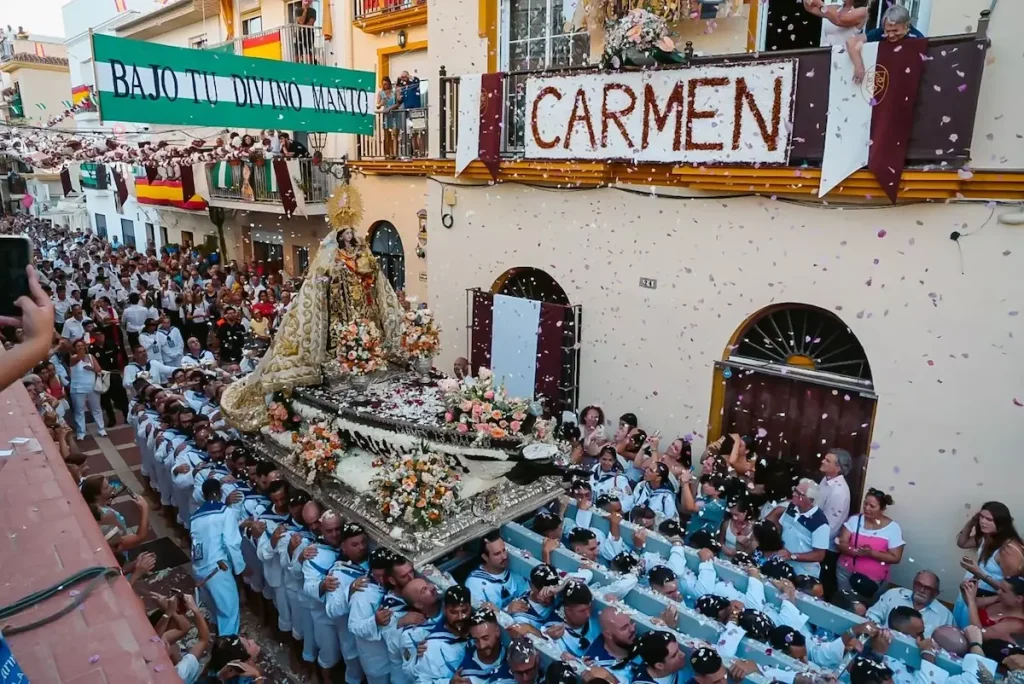 The Virgen del Carmen is the patron saint of sailors and fishermen across Spain, and coastal communities all along the Costa del Sol hold their own version of her festival each summer. La Carihuela’s roots go back to its identity as a working fishing village, long before Torremolinos became a resort town. The festival keeps that maritime heritage alive: the community still gathers to bless the sea and give thanks for safe passage, a tradition that predates the sun loungers by generations.
What Happens During the Festival
Across the week, La Carihuela fills with strings of festive lighting, a municipal marquee (caseta) hosting live bands and orchestras, a separate youth marquee with DJs and younger acts, funfair rides for children, and a steady stream of food stalls serving up the neighbourhood’s famous seafood. The atmosphere spills out onto the streets and along the seafront promenade, with locals and visitors mixing freely — there’s no ticket or invitation needed for any of it. The emotional peak falls on the feast day itself, usually 16 July. The image of the Virgin is carried out of the Church of Nuestra Señora del Carmen and processed through La Carihuela’s narrow streets down to the beach. From there she’s placed aboard a traditional jábega fishing boat and taken out along the Torremolinos coastline, escorted by a flotilla of fishing boats and pleasure craft. Watching this maritime procession from the sand, with hundreds of neighbours and visitors lining the shore, is one of the most authentic experiences you can have in Torremolinos.Best Things to See
- The maritime procession and boat blessing on the feast day
- The land procession from the church down to the beach
- Decorated fishing boats moored along the shore
- Live music at the municipal and youth marquees
- Traditional dress worn by many participants
- Late-evening atmosphere along the La Carihuela seafront, once the heat of the day has passed
Best Time to Visit
Arrive at the church side of La Carihuela in the late afternoon on the feast day to follow the procession down to the sea — this is also the best window for photography, as the light softens before sunset. Evenings from around 9pm onward are when the marquees and street atmosphere really pick up. Because this is a genuinely local celebration rather than a tourist-oriented one, expect narrow streets to get busy near the church and beachfront during the main procession, so arrive with time to spare if you want a good vantage point.Feria de Málaga: A Day Trip Worth Planning For
Once August arrives, the celebrations shift a few kilometres up the coast for something on a much bigger scale. The Feria de Málaga runs for eight days, marking the anniversary of the city’s reconquest by the Catholic Monarchs in 1487, and it’s one of the most famous ferias in Andalusia after Seville’s.How the Fair Works
Unlike smaller neighbourhood ferias, Málaga’s fair splits into two distinct experiences on the same day. During daylight hours, the party is in the historic centre: streets like Calle Larios and Plaza de la Constitución fill with dancing, tapas bars, and verdiales — Malaga’s own folk music played by hat-wearing troupes on guitar and tambourine. Once the sun goes down, the action moves to the Real del Cortijo de Torres fairground on the edge of the city, where casetas (fair tents), funfair rides, and concerts run into the early hours. Crucially, entry to the casetas is free and open to everyone — you don’t need an invitation, unlike some other regional ferias.Getting There from Torremolinos
The good news is Torremolinos couldn’t be better positioned for a day trip into Málaga. Here’s how to make the journey.Train (Cercanías C1)
The Cercanías C1 line runs directly from Torremolinos station into Málaga Centro-Alameda, right in the heart of the daytime fair zone. The journey takes around 20–25 minutes, with trains departing roughly every 20–30 minutes throughout the day. It’s a short, flat walk from Málaga-Centro Alameda station into Calle Larios and the main fair action. A single ticket is typically in the region of €1.80–€3.60 depending on the fare zone.Bus
Regional and local buses also connect Torremolinos with Málaga, with a journey time of around 30–40 minutes depending on traffic and stops. Fares are broadly similar to the train, and buses can be a handy backup if you miss a train or are travelling later at night when frequency drops.Taxi
A taxi from Torremolinos to central Málaga typically runs somewhere in the region of €25–€35 during the day, with evening and night fares (common during feria week, when trains and buses get busy) running a little higher. The journey takes roughly 15–20 minutes by road, traffic depending. Uber and Bolt both operate in the area and can be a convenient option for the return leg late at night, when queues for taxis at the fairground can get long.Driving
Driving into Málaga during feria week is best avoided if you can help it — parking near the historic centre becomes scarce and street closures are common around Calle Larios and the fairground. The train is genuinely the easier option for this trip.Approximate Transport Costs
| Transport | Approx Cost | Journey Time |
|---|---|---|
| Cercanías train | €1.80–€3.60 | 20–25 min |
| Bus | €1.50–€3.50 | 30–40 min |
| Taxi (day) | €25–€35 | 15–20 min |
| Taxi (night/feria week) | €30–€45 | 15–20 min |
Best Time to Visit
If you only have one day, come for the afternoon daytime fair in the centre, then take the train back to Torremolinos before the crowds peak, or push on to the night fairground if you’re prepared for a late one — the atmosphere really only gets going after 9pm and runs until the early hours. Weekday afternoons tend to be calmer than weekends if you’d rather avoid the biggest crowds.Tips for Tourists
- Wear comfortable shoes — you’ll be on your feet and on cobbled streets for hours
- Bring water and take breaks in the shade during the day fair; August heat in Málaga is intense
- Expect large crowds, especially in the evenings and at weekends
- Use the train where possible — it avoids parking and traffic headaches entirely
- Keep valuables secure in busy areas, as with any large public event
- Check the last train times back to Torremolinos if you’re staying for the night fair
What to Eat at Both Festivals
Food is central to both celebrations. In La Carihuela, look out for espetos — sardines skewered on a cane and grilled over an open fire on the beach, a Malagueño classic that originated in exactly this kind of fishing neighbourhood — alongside boquerones (fried anchovies) and cold tinto de verano to cut through the summer heat. At the Málaga fair, alongside the same seafood staples, you’ll find paella served from huge pans, fresh churros for a sugar hit between dancing, and stalls selling local desserts alongside the tapas bars lining Calle Larios.Nearby Attractions Worth Combining With Your Trip
If you’re already making the trip into Málaga for the fair, it’s worth building in time for some of the city’s other highlights: the Alcazaba fortress, the Roman Theatre beneath it, Málaga Cathedral, the Picasso Museum, and the waterfront promenade at Muelle Uno all sit within easy walking distance of the historic centre.Book Ahead
To make the most of a day in Málaga around fair time, consider booking a guided walking tour, an Alcazaba skip-the-line ticket, or a Picasso Museum entry in advance, since queues build quickly during feria week.Recommended Tours
Powered by GetYourGuide
- Málaga Evening Flamenco Show
- Private Transfer, Torremolinos to Málaga (useful for feria week when trains get crowded)
